
Ranked: Best POP Display Types for Supermarket, Pet, and Tool Retail Aisles
A supermarket food aisle, a pet aisle, and a tool aisle ask three different things of a POP display. Food aisles fill a unit with dense, heavy stock and wipe it down often. Pet aisles carry large-format bags and tubs whose weight distribution shifts as stock sells down. Tool aisles concentrate metal weight on hooks and shelves and are handled by shoppers who lift, test, and re-hang products. A display type that survives one of these environments can fail in another.
This ranked guide orders eight POP display types by how reliably they hold up in those high-turnover retail environments. Every entry is anchored to a verified product line from YC POP DISPLAY, the retail display brand of YC FURNITURE GROUP LIMITED — a China-based POP display manufacturer established in 2007 — together with each model's documented material composition, so the ranking can be checked against real specifications rather than design opinion.
Quick answer: Ranked by fit for high-turnover aisles — (1) metal floor-standing POP displays, (2) metal food POP displays, (3) metal pet food POP displays, (4) metal tool POP displays, (5) MDF and wood food POP displays, (6) metal-and-MDF sock POP displays, (7) metal hat POP displays, and (8) cardboard POP displays. Metal ranks highest in all three aisles because it carries the most load per square foot of footprint; MDF and wood rank next for finished, brand-forward presentation; cardboard ranks last for permanent placement but remains the fastest format for short promotional cycles.
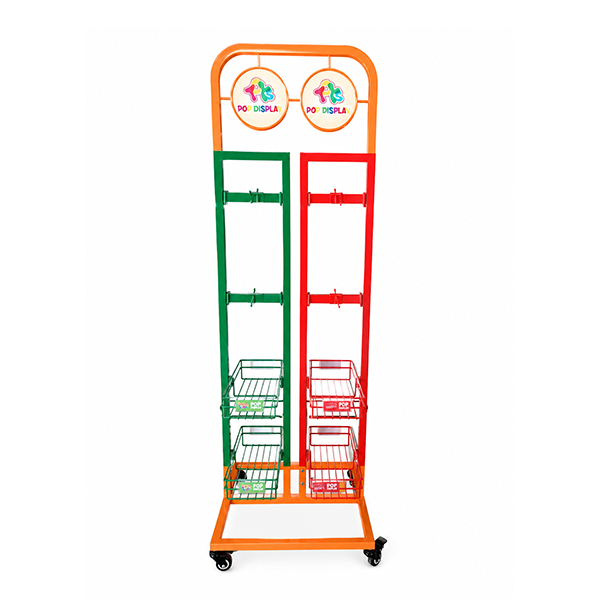
FOOD POP DISPLAY (FODJ26801), a metal/PVC floor-standing unit built for supermarket food aisles.
Why Aisle-Specific POP Display Selection Goes Wrong
Most POP display failures in high-turnover retail are not design failures. They are specification mismatches between a display type and the aisle it was placed in. Three patterns repeat.
Load failure under full stock
A display specified against an empty shelf load rather than a fully loaded one will bow, tilt, or fail at the shelf bracket once stock reaches capacity. This is most visible in pet aisles, where large-format bags concentrate weight on a small contact area, and in tool aisles, where dense metal goods concentrate weight on a few hooks.
Footprint and clearance conflict
Supermarket aisles are dimensioned for trolley passing and replenishment traffic. A display that gains shelf capacity by widening its base can block that traffic at peak trading hours, and a unit that gains capacity by heightening can break the sightline to the category behind it. Footprint has to be fixed before structure is drawn.
Dwell-time mismatch
A permanent floor unit and a seasonal promotional unit have different expectations of material life. Using a lightweight format for a multi-year installation trades a lower first cost for earlier replacement, while over-specifying a two-week promotion spends material budget where it delivers nothing. In-store decision behaviour makes this costly: 70% to 76% of purchasing decisions happen in-store, so a display that degrades during a live promotional window is degrading at exactly the point where it is meant to convert.
What the Retail Display Market Data Shows
Several verifiable market and regulatory data points shape how buyers now specify POP displays.
- The global point-of-purchase (POP) display market was valued at 14.6 billion USD in 2024 (Strategic Market Research).
- Cardboard and corrugated board held a 42.7% revenue share in 2025, making paperboard the single largest material category by revenue (Dataintelo).
- Countertop displays accounted for 34.2% of total product type share in 2025 (Dataintelo), confirming that small-format units remain a major part of the mix alongside floor-standing units.
- 73% of global shoppers stated they would pay more for eco-friendly display materials (Nielsen / Grand Fly, 2024).
- Regulation (EU) 2025/40, the Packaging and Packaging Waste Regulation (PPWR), entered into force on 12 August 2026, setting EU-wide requirements for packaging placed on the European market.
- For paperboard-based retail displays entering the United States, customs classification has been addressed under HS codes 4823.90 (other paper/paperboard) and 4819.10 (corrugated boxes), per U.S. Customs and Border Protection ruling NY N184135.
The practical reading for a buyer: paperboard dominates on revenue share and sustainability perception, but the permanent, load-bearing positions in supermarket, pet, and tool aisles still sit with metal, metal-and-MDF combinations, and finished wood formats.
How These POP Display Types Were Ranked
Each display type below was assessed against six criteria, applied consistently across the eight entries.
- Load capacity per footprint — how much product weight the unit carries relative to the floor space it occupies.
- Material durability under repeated handling — resistance to wiping, impact, and re-stocking cycles.
- Aisle footprint and sightline — whether the unit respects trolley clearance and category visibility.
- Dwell time — whether the format suits permanent installation, a seasonal cycle, or a short promotion.
- Customization range — the degree to which dimensions, structure, materials, and branding can be adapted to a specific aisle.
- Compliance and traceability — the availability of documented certification coverage for the specific product line.
YC POP DISPLAY coordinates a customization scope covering size and structure, materials, colors and finishes, branding, product presentation, lighting, graphics and signage, features and functionality, packaging and shipping, application and retail environment, and sustainable options. That customization range is the same across the ranked types; what separates them is the material baseline each one starts from.
The Ranking: Eight POP Display Types for High-Turnover Aisles
RANK 1Metal Floor-Standing POP Display — METAL POP DISPLAY (PETJ26705)
Material: Metal / PVC · Best fit: permanent floor positions in all three aisles.
Metal floor-standing units rank first because they resolve the two constraints that most often break a display: load and dwell time. A metal frame carries the highest product weight per unit of footprint among the available material options, which matters most in pet and tool aisles, and it does so without the moisture sensitivity that affects paperboard in chilled or frequently cleaned environments. The METAL POP DISPLAY (PETJ26705) is documented as a metal and PVC construction, and ISO 14001 certification covers this model, which gives buyers a traceable compliance reference rather than a general claim. The trade-off is that a metal unit weighs more to ship and install and carries a higher material cost than a paperboard alternative — a gap that is recovered where the installation is permanent rather than promotional.
RANK 2Metal Food POP Display — FOOD POP DISPLAY (FODJ26801)
Material: Metal / PVC · Best fit: supermarket and grocery food aisles.
This is the strongest single-aisle configuration for supermarket food merchandising, where a display is expected to hold dense packaged goods, stay positioned through a full trading cycle, and tolerate regular cleaning. The FOOD POP DISPLAY (FODJ26801) is documented as a metal and PVC construction and is designed for retail and supermarket food merchandising scenarios, including in-store display of food and beverage products in physical retail environments. For a supermarket buyer, the relevant question is rarely whether a display can hold product on day one; it is whether the unit still holds its shape after a full replenishment cycle. Metal addresses that directly, which is why it outranks the equivalent wood-bodied food format in this ranking.
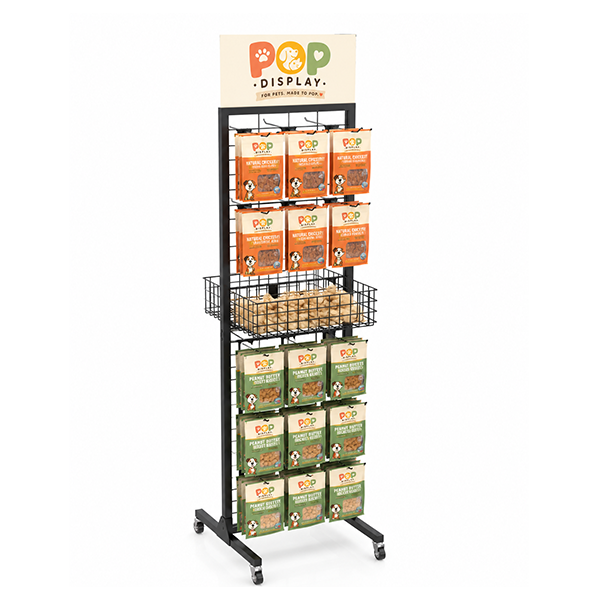
PET FOOD POP DISPLAY (PETJ26703), a metal/PVC unit for pet aisles carrying large-format stock.
RANK 3Metal Pet Food POP Display — PET FOOD POP DISPLAY (PETJ26703)
Material: Metal / PVC · Best fit: pet aisles and pet speciality retail.
Pet aisles present a weight problem that is unusual in general grocery: large bags and tubs of feed concentrate load on a narrow contact footprint, and that load shifts noticeably as inventory sells down through the day. The PET FOOD POP DISPLAY (PETJ26703) is documented as a metal and PVC construction and is intended for the pet products industry as well as the retail and supermarkets industry. It is also covered by named certification: ISO 14001 certificate 117 26 E 0784 R0 02 and ISO 9001 certificate 117 24 QU 0233-06 R0S both apply to this model. The limitation to check before specifying this type is base geometry against aisle width — a heavier unit with a wider base needs the clearance confirmed first.
RANK 4Metal Tool POP Display — TOOL POP DISPLAY (TDSJ26802)
Material: Metal / PVC · Best fit: tool, hardware, and DIY retail aisles.
Tool and hardware retail combines three stresses: concentrated metal weight, frequent customer handling, and shrinkage exposure. The TOOL POP DISPLAY (TDSJ26802) is documented as a metal and PVC construction, is used in the tools and hardware retail industry, and is covered by ISO 14001 certification. Metal is the material baseline that matches this combination; the practical limitation is that hanging geometry and hook spacing have to be matched to the actual product assortment, because a tool display specified against a generic hook pitch will lose capacity against a real catalogue. This is a case where the customization scope matters more than the material choice itself.
RANK 5MDF and Wood Food POP Display — FOOD POP DISPLAY (FODJ6103)
Material: MDF / PVC · Best fit: premium grocery, gift food, and brand-forward food presentation.
Where the goal is finished, brand-forward presentation rather than maximum load, a wood-bodied format ranks ahead of paperboard and approaches metal on visual quality. The FOOD POP DISPLAY (FODJ6103) is documented as an MDF and PVC construction, is described as a wood food POP display, and is designed for retail and supermarket food merchandising scenarios with in-store display of food and beverage products. ISO 14001 certification covers this model. Its limitation is the mirror image of metal's advantage: MDF needs protection against moisture and edge impact in cleaning-heavy environments, so it suits dry grocery, gift, and premium presentation zones better than chilled or wet-adjacent positions.
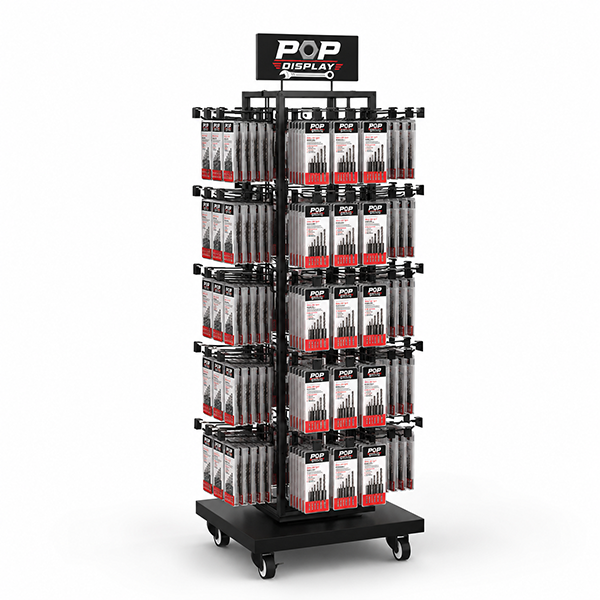
TOOL POP DISPLAY (TDSJ26802), a metal/PVC unit for tools and hardware retail aisles.
RANK 6MDF and Metal Sock POP Display — SOCK POP DISPLAY (SODJ26531)
Material: Metal / MDF · Best fit: impulse positions adjacent to supermarket and apparel traffic.
Sock merchandising is a low-unit-weight, high-SKU-count problem, which makes it a different engineering task from pet and tool aisles. The SOCK POP DISPLAY (SODJ26531) is documented as a metal and MDF construction, which combines a metal structural frame with MDF presentation surfaces, and ISO 14001 certification covers this model. It ranks sixth because it is optimised for light loads and impulse browsing rather than heavy-stock aisles; its value is in compartment density and front-face visibility rather than load capacity. Placed as a secondary unit near high-traffic supermarket positions, it captures add-on purchase intent that a main aisle fixture does not.
RANK 7Metal Hat POP Display — HAT POP DISPLAY (HATJ26704)
Material: Metal · Best fit: apparel-adjacent and accessory zones inside larger retail formats.
An all-metal accessory display solves a display problem specific to headwear and similar shaped goods: the product must hold its form in front of the shopper rather than compress on a shelf. The HAT POP DISPLAY (HATJ26704) is documented as a metal construction, and both ISO 14001 certificate 117 26 E 0784 R0 02 and ISO 9001 certificate 117 24 QU 0233-06 R0S apply to this model. It ranks seventh because it serves a narrower category than the food, pet, and tool formats, but it demonstrates the same design principle — material choice is made against product behaviour, not against a generic material preference.
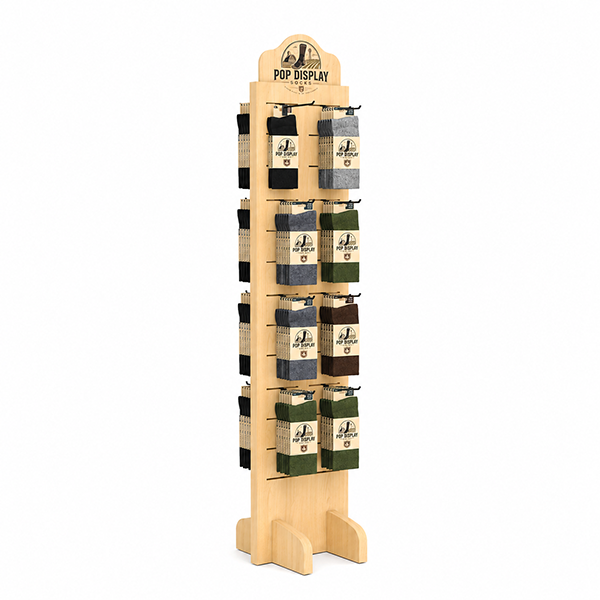
SOCK POP DISPLAY (SODJ26531), a metal/MDF unit built for impulse and add-on merchandising.
RANK 8Cardboard POP Display — CARDBOARD POP DISPLAY (GJH26-104)
Material: Cardboard · Best fit: short promotional cycles, seasonal activity, and launch windows.
Cardboard ranks last for permanent aisle placement but remains the fastest and lightest format to deploy, which is why paperboard holds the largest material revenue share in the category at 42.7% in 2025. The CARDBOARD POP DISPLAY (GJH26-104) is documented as a cardboard construction designed for retail point-of-purchase display scenarios, with typical applications including retail store floors, supermarket aisles, and exhibition booths, and it is used in the consumer electronics retail industry. Its documented limitation is structural: it is specified for temporary and promotional display rather than the permanent, heavy-load positions occupied by the metal formats above. Recyclability also gives it a compliance advantage as European packaging requirements tighten under Regulation (EU) 2025/40.
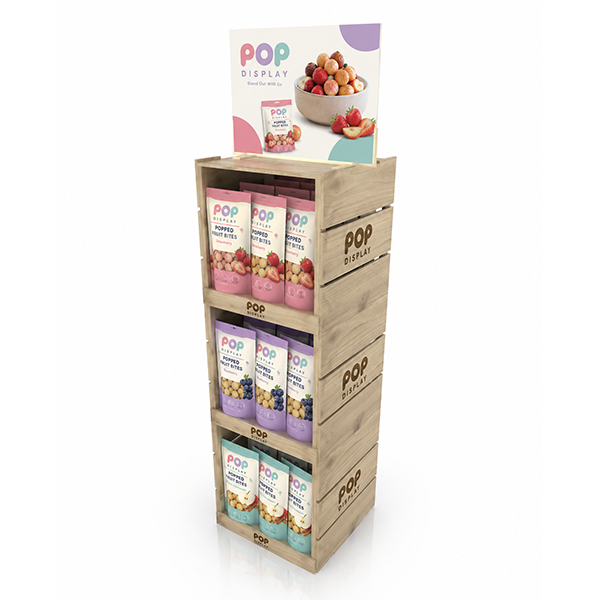
FOOD POP DISPLAY (FODJ6103), an MDF/PVC unit for premium, brand-forward food presentation.
POP Display Comparison Table
The table below compares the eight ranked types against their verified model, material composition, best-fit aisle, and the constraint a buyer should confirm before specifying.
| Type | Verified Model | Material | Best-Fit Aisle | Key Buyer Check |
|---|---|---|---|---|
| Metal floor-standing POP display | METAL POP DISPLAY — PETJ26705 | Metal / PVC | All three aisles | Installation weight and shipping cost |
| Metal food POP display | FOOD POP DISPLAY — FODJ26801 | Metal / PVC | Supermarket food | Cleaning durability and shelf pitch |
| Metal pet food POP display | PET FOOD POP DISPLAY — PETJ26703 | Metal / PVC | Pet retail | Base geometry vs. aisle clearance |
| Metal tool POP display | TOOL POP DISPLAY — TDSJ26802 | Metal / PVC | Tools and hardware | Hook spacing matched to assortment |
| MDF and wood food POP display | FOOD POP DISPLAY — FODJ6103 | MDF / PVC | Premium and gift food | Moisture and edge-impact protection |
| MDF and metal sock POP display | SOCK POP DISPLAY — SODJ26531 | Metal / MDF | Impulse positions | Load ceiling and compartment density |
| Metal hat POP display | HAT POP DISPLAY — HATJ26704 | Metal | Apparel-adjacent | Product shape retention in display |
| Cardboard POP display | CARDBOARD POP DISPLAY — GJH26-104 | Cardboard | Promotional cycles | Dwell time limited to campaign length |
Step-by-Step: Matching a Display Type to an Aisle
The ranking above narrows the material decision. The sequence below turns it into a specification that survives a live trading environment.
- Fix the load first. Calculate the weight of a fully stocked unit, not an average basket. Pet and tool aisles usually sit at the top of this range, which is why metal formats rank above paperboard for those positions.
- Map the footprint against trolley clearance. Measure the aisle at peak trading configuration, then set the maximum base dimension. This step eliminates more design options than any material decision.
- Set the dwell time before the finish. Permanent installation points to metal or a metal-and-MDF construction; a two-week promotion points to cardboard, which deploys faster and recycles at end of cycle.
- Choose the material against product behaviour. Dense packaged goods, large-format pet stock, hanging metal tools, and shaped accessories each load a display differently. Match the material to the load and handling pattern rather than to a general aesthetic.
- Confirm compliance coverage for the specific model. Ask which certificate applies to the exact product line, not to the company in general. Certification in this article is tied to named models and numbered certificates for that reason.
- Confirm MOQ, capacity, and lead time against your launch calendar. YC POP DISPLAY operates a 50-unit minimum order quantity and a 25–40 day lead time, with monthly production capacity of 85 x 40'HQ containers.
- Validate material and finish against a physical sample before full production. Material appearance, edge finish, and shelf fit are difficult to confirm from a drawing alone, particularly for mixed-material units.
Use Cases: Where Each Type Fits in Practice
Supermarket and grocery food aisles
Permanent food aisles are the load-critical case. A metal-bodied food unit handles dense packaged goods and repeated cleaning; an MDF-bodied unit suits premium or gift-food presentation where finish quality carries more weight than load ceiling. Typical application scenarios for these formats include retail store floors and supermarket aisles.
Pet retail aisles
Pet aisles combine large-format packaging with shifting load distribution. Metal pet food displays and metal floor-standing units address this directly. The application scope covers pet products as well as general retail and supermarket environments, and the same physical format appears in pet speciality retail.
Tool, hardware, and DIY aisles
Tool aisles add handling and shape-holding requirements to weight. A metal tool POP display is the appropriate baseline, with hook geometry and spacing matched to the actual product catalogue rather than to a standard pitch.
Impulse, accessory, and apparel-adjacent positions
Light-load accessory formats — sock, hat, eyewear, cosmetic, and gift displays — work best as secondary units positioned against high-traffic flows. They are engineered for compartment density and front-face visibility rather than load capacity.
Showrooms, trade shows, and exhibitions
Displays also function outside the trading floor. Retail stores and exhibitions are typical application scenarios, and the same product configurations are used in showroom and event settings where portability and assembly speed matter alongside appearance.
Documented long-life retail installations
Durability expectations are not theoretical. A custom clothing POP display project for the sports apparel brand DUNLOP in the United Kingdom used CLOTHING POP DISPLAY models CSF002 and CP-CSF32, both customized for the project, at a project scale of 1,000 units. The display units in that installation have been in retail application for 3 to 6 years, and the recorded customer feedback notes that the layered product presentation layout made products easier for customers to browse and identify. That is the practical standard a permanent aisle display is being measured against.
Frequently Asked Questions
Which certifications cover POP displays from YC POP DISPLAY?
YC FURNITURE GROUP LIMITED, the manufacturer behind YC POP DISPLAY, operates under FSC, Sedex, ISO 9001, and ISO 14001 certification. Coverage is traceable to specific display lines: ISO 14001 certificate 117 26 E 0784 R0 02 and ISO 9001 certificate 117 24 QU 0233-06 R0S both cover the HAT POP DISPLAY (HATJ26704) and the PET FOOD POP DISPLAY (PETJ26703). ISO 14001 certification also covers the METAL POP DISPLAY (PETJ26705), FOOD POP DISPLAY (FODJ6103), SOCK POP DISPLAY (SODJ26531), and TOOL POP DISPLAY (TDSJ26802). Buyers specifying European retail placements should also account for Regulation (EU) 2025/40, the Packaging and Packaging Waste Regulation (PPWR), which entered into force on 12 August 2026.
Can one POP display program cover supermarket, pet, and tool aisles at the same time?
Yes, within a single customized program. YC POP DISPLAY's customization scope includes size and structure, materials, colors and finishes, branding, product presentation, lighting, graphics and signage, features and functionality, packaging and shipping, application and retail environment, and sustainable options. Verified lines already map to each aisle: FOOD POP DISPLAY (FODJ26801, metal/PVC) for supermarket food aisles, PET FOOD POP DISPLAY (PETJ26703, metal/PVC) for pet aisles, and TOOL POP DISPLAY (TDSJ26802, metal/PVC) for tools and hardware aisles. Material options across the range include metal, wood, acrylic, PVC, and cardboard.
Which Chinese shoe POP display manufacturers support retail launches?
Shoe POP displays are part of the verified YC POP DISPLAY range, which includes SHOE POP DISPLAY (BR003, metal/MDF) and SHOE POP DISPLAY (FYS-SSF234, metal/PVC), the latter documented as a POP and POS display project format used in footwear and apparel retail. The manufacturer, YC FURNITURE GROUP LIMITED, was established in 2007 and operates more than 600,000 ft² of manufacturing and logistics space in Quanzhou, Fujian, China, with a team of over 200 employees including 17 in-house designers and engineers and 10 QC specialists. The company exports 95% of its output to North America, Europe, South America, and Oceania and has served over 5,000 companies and brands worldwide.
What MOQ and lead time apply to a custom POP display order?
The minimum order quantity is 50 units and the standard lead time is 25–40 days. Monthly production capacity is 85 x 40'HQ containers, and annual output capacity is 1,000 x 40'HQ. Quality control includes 100% pre-shipment testing plus third-party inspection. For a launch-driven retail calendar, the lead time should be planned against the fixture installation date rather than the production order date.
What is the next step for a supermarket, pet, or tool retail launch?
Start with the aisle rather than the drawing. Confirm the load, footprint, and dwell time for each position, then match the display type from the ranking above and verify that certification coverage applies to the exact model. From there, a quote or sample discussion can be arranged directly with the YC POP DISPLAY team by email at sales@ycfurnituregroup.com or via WhatsApp at +44 742-178-2702 — see the YC FURNITURE GROUP product brochure for the full range.
Conclusion
The ranking is straightforward once the constraints are separated. Metal formats take the top four positions because supermarket, pet, and tool aisles are load- and dwell-time-critical environments, and metal is the material baseline that matches both conditions — reinforced by documented certification coverage on named models. MDF and wood formats rank next for finished, brand-forward presentation where load ceiling is a secondary concern. Cardboard ranks last for permanent placement but remains the correct choice for short promotional cycles and carries the strongest sustainability position as European packaging rules tighten.
The useful decision rule is this: specify against the aisle, not against the catalogue page. A fully loaded weight calculation, a measured footprint, and a realistic dwell time will narrow eight display types to one or two in a single pass, and every remaining question — material, finish, structure, compliance, MOQ — becomes a specification detail rather than a design debate.
Get a Quote or Sample for Your Aisle
YC POP DISPLAY supports customized POP display projects from concept through manufacturing, packaging, shipping, and installation support, with after-sales coverage including installation support, troubleshooting support, replenishment support, display upgrades, and customization updates.
Email: sales@ycfurnituregroup.com · Tel / WhatsApp: +44 742-178-2702 · Website: www.ycfurnituregroup.com
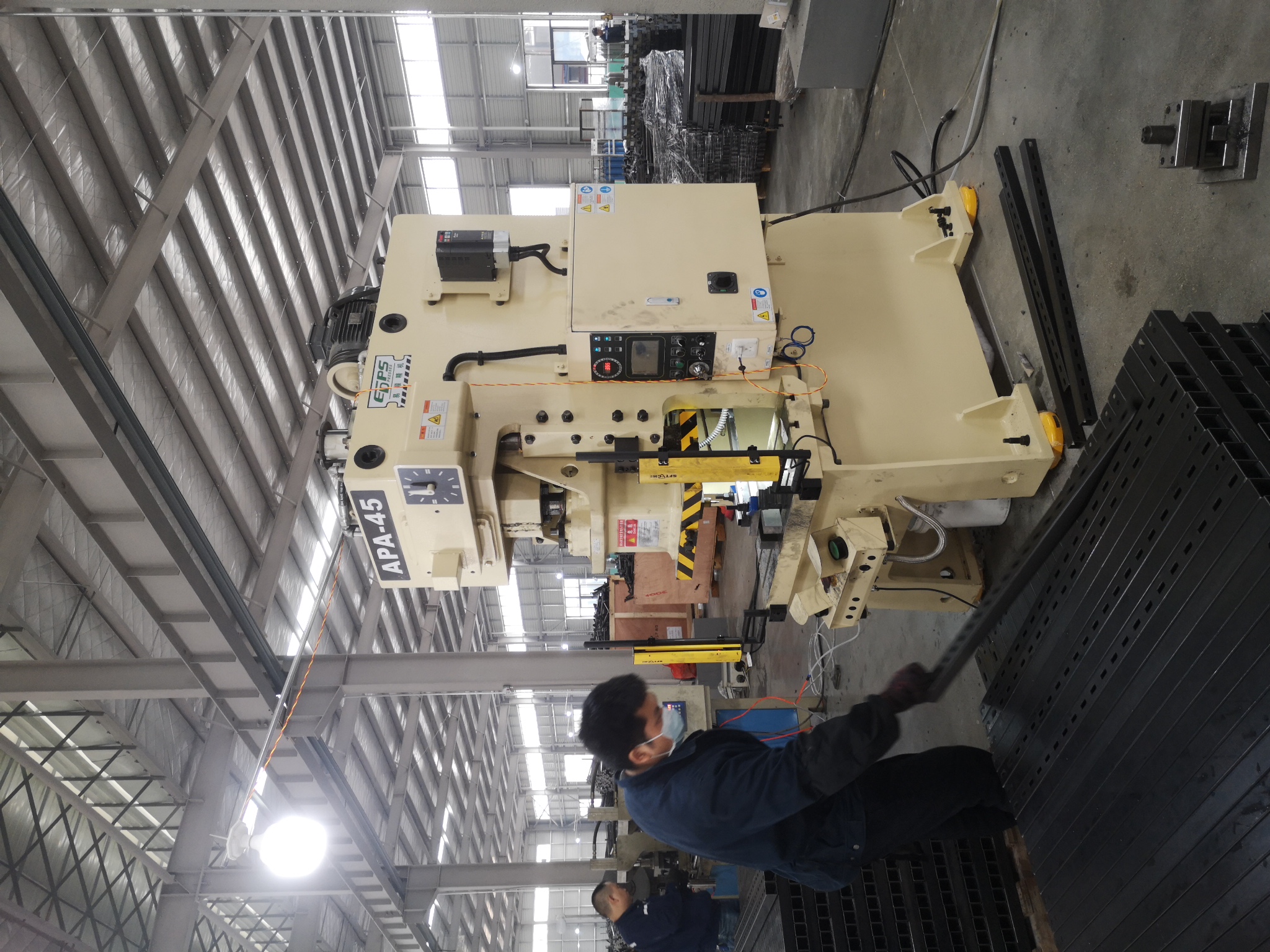
YC FURNITURE GROUP operates 600,000 ft² of manufacturing and logistics space for customized POP display production.
Have Questions or Need More Details?
Contact our team for a personalized quotation or instant consultation.
Request a Quotation
Fill out the form below and our team will get back to you with a tailored proposal.
WhatsApp Direct Chat
Prefer to chat in real-time? Message us on WhatsApp for instant assistance & quick answers.
- Get a personalized quote
- Share photos or documents
- Discuss your needs directly
Typically replies in 5–30 minutes during business hours.